Sun position, not just clock hands
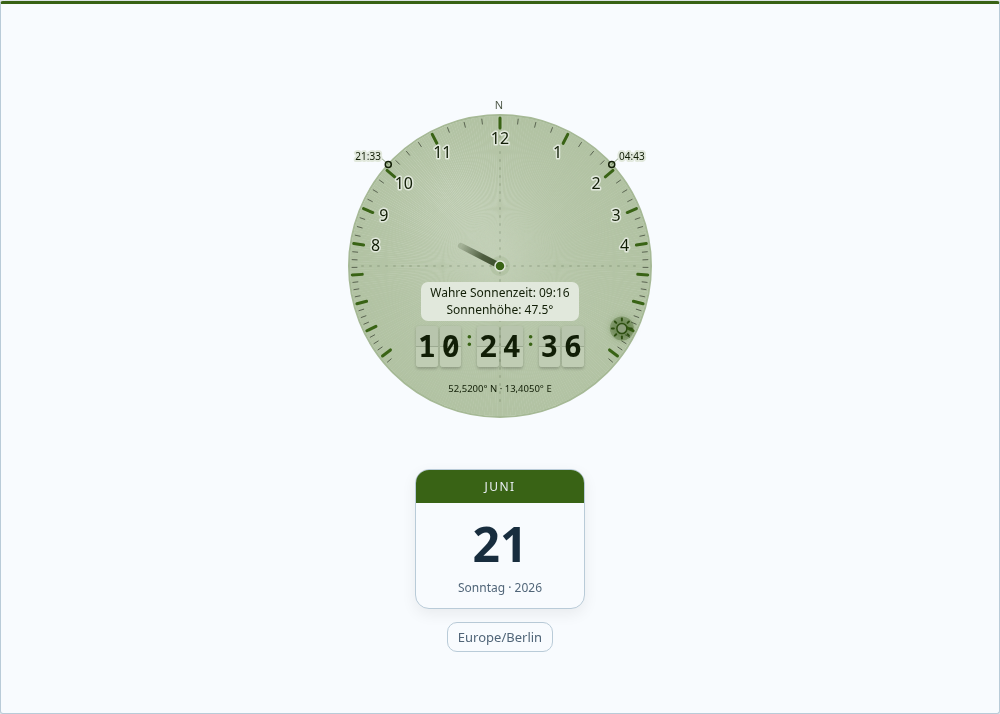
Using SunCalc, the sundial calculates the Sun’s position from the date, device time, latitude and longitude. Altitude is the angle above the horizon; azimuth is the compass direction. A virtual vertical pin casts its shadow away from the Sun onto a horizontal dial. This is not a traditional gnomon aligned with Earth’s axis.
A little trigonometry
For pin height H and solar altitude α, shadow length on the horizontal plane is L = H / tan(α). A high Sun makes a short shadow; a low Sun makes a long one. Below the horizon, no solar shadow is shown. For readability, long shadows are clipped and very short ones enlarged: the visible length is not a scale measurement. Hour marks are calculated for the date and location; orientation also accounts for the southern hemisphere and the tropics.
Why two different times?
Apparent solar time follows the local Sun: its upper meridian transit marks solar noon. The code converts the solar hour angle into hours, at 15 degrees per hour. Flip digits instead show civil time in the selected time zone. Longitude, the equation of time and daylight saving can make the readings differ. Sunrise and sunset are calculated too and shown in the selected zone; during polar day or night, those events may not occur.
Try it with deliberate location permission
Choose Sundial, enable Location-based simulation and allow location access in your browser. The clock processes coordinates locally and neither stores nor transmits them. Position changes are tracked while the location mode is actively used. Your device time must be correct; the time zone remains a separate setting. This sundial is a visualization, not a precision instrument.
Three rings instead of three hands
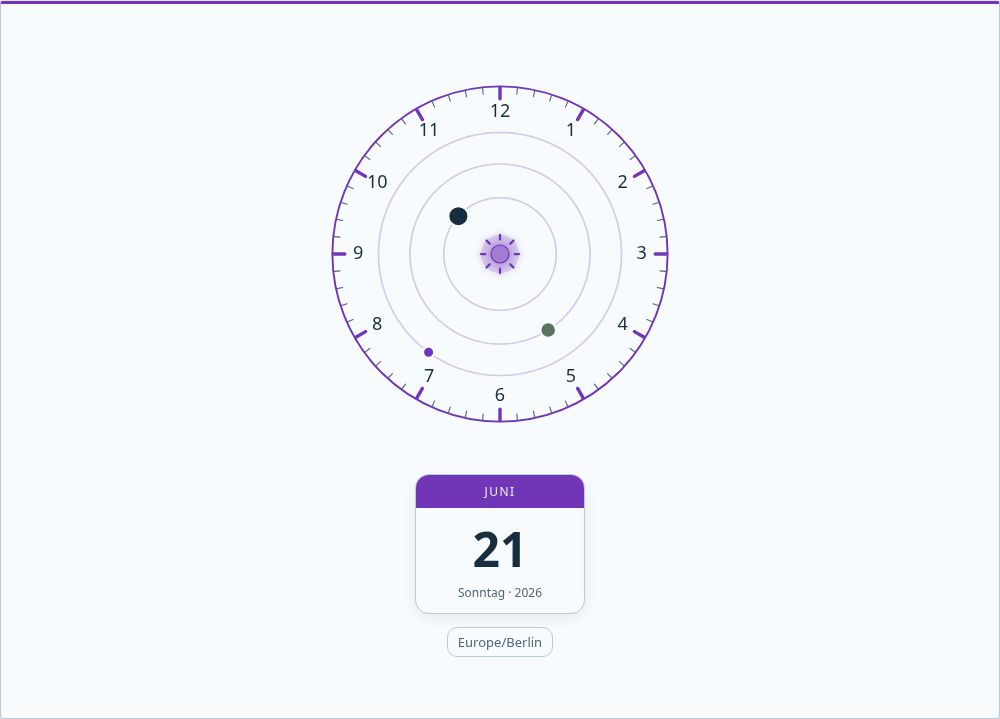
The orbit clock puts hours on the inner ring, minutes in the middle and seconds outside. Seconds can tick or flow smoothly. A small glowing Sun sits at the centre. Dial style, round or square shape, Roman numerals and colours follow your settings.
This view was inspired by our sound tool, which is currently in development. We brought the idea of orbiting elements to the clock: instead of hands, small dots move along their rings. This makes the passage of time visible as motion around a shared centre. Unlike the sundial, these orbits are a visual representation of clock time, not a calculation of astronomical planetary orbits.